Wednesday, November 11, 2009

Social Media's Effect on Non-Passive Consumers

For people who use social media for personal reasons, it can be a very successful tool for staying in touch with people and learning about the latest trends. For businesses, I think social media allows for them to have an enormous competitive advantage. If a company reaches out to their current consumers and finds ways to contact future consumers, they can build relationships that have the potential to greatly increase sales and raise awareness about promotional events and products.

Another way to successfully use social media sites is to respond to both positive and negative feedback from their customers. This gives customers incentive to express their opinions, which in turn can benefit both future consumers and the store itself. As we discussed in class, customers feel an intrinsic motivation to share their ideas and experiences with others, and with social media sites, this can happen almost instantaneously. Thus, it is more important than ever for companies to take advantage of this situation and find ways to positively reinforce their customers who do interact with them through social media. I think one of the best ways that companies can reach out to consumers is to use social media sites, namely Twitter, to push their promotions to their customers. By posting information on Twitter about special discounts for followers or sneak-previews to a promotion that would start a day early for followers, companies would effectively give their customers a tangible reason to follow them and create a unique customer experience.
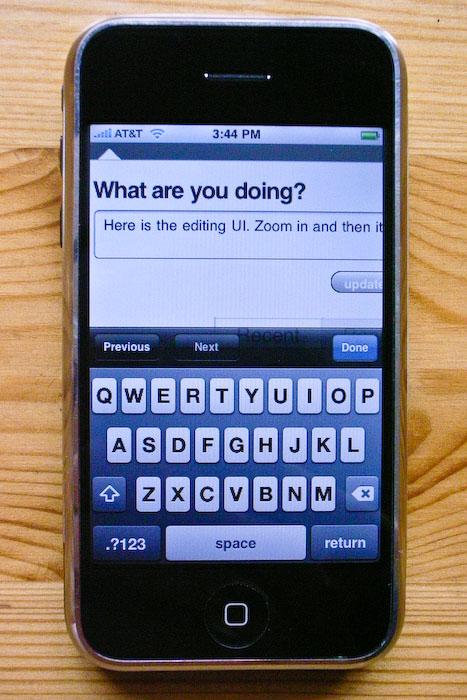
Another way Twitter can be beneficial is that reading their customers’ opinions allow companies to gain insights into the lives of their customers and see what their daily routines are. In turn, this would allow developers to read about people’s frustrations and potentially create products that customers might not even realize they have a need for yet. These predictions would be extremely profitable. Even more, if companies reach out to customers through social media sights rather than just taking a passive approach and reading their opinions, they could push new ideas towards their customers and rate their feedback. For instance, using Twitter, they could post links or pictures of new products/ideas/surveys and assess the responses they receive. This allows the company to receive free, instant feedback from customers who are actually interested in their products. The feedback would help in the design process, and would allow customers to feel involved.

I chose to use the Google Zeitgeist tool to research the Texas Longhorn Football Team to see what results would come up. One of the tools showed a search volume index over the last 5 years when the UT football team was searched. The trends for each year are surprisingly similar. Between the third and fourth months of every year, the number of searches skyrocket. Also, around December/January of 2005 and 2006, the results were higher than ever, obviously attributed to the National Championship title game. This could be an extremely helpful tool for companies to determine what time periods attract customers the most to their store. Once they figure this out, they could pinpoint which time periods would be the most effective to send out promotions.

In a lecture delivered to the St. David’s Episcopal Church group on November 7, 2009, Bob Johansen noted, “The world ‘consumer’ is obsolete, we all need to quit using it. It is too passive.” The prominence of social media to discuss experiences and products is a perfect reinforcement for Bob’s statement. We are no longer just passive consumers. We have ideas and expectations about the products and services we receive, and we are motivated to share them. Social media is a great tool for this because it allows us to share our ideas as we are using the products, and it allows for others to read, comment, and then use our opinions to help formulate their own actions. In closing, social media, while it may be just a fun past-time for product-users, can be used by companies to connect with their followers and involve them while creating unique customer experiences.

Wednesday, November 4, 2009

Trading Privacy for Competitive Advantage

Some of the information provided in the article, “What Wal-mart Knows About Customers’ Habits,” by Constance L. Hays, was very shocking to me. The fact that Wal-mart has gathered and stored twice as much information about their customers as is available on the Internet is unbelievable. Obviously this is very powerful information, and the executives at Wal-mart have used it very well to have efficient processes and forecast customers’ needs on a daily or weekly basis.

Now that I’m aware of the extreme amounts of personal information that Wal-mart has on record about both me and my purchases, I’m surprised that I’ve never seen any marketing or promotions tailored towards me. Wal-mart has always been successful when using checkout data to analyze trends, budget the number of cashiers needed per hour, and forecast which items are going to be the most profitable on shelves. However, they have never used this data to make customers aware of how they capture insights, nor have they created great, personal experiences for shoppers that give them a competitive advantage.

Recently, Wal-mart’s rival company, Target, has been distributing coupons attached to receipts that are based on the their customer’s past purchases. One provider of this technology is a company called Catalina, who currently has their systems installed in 6,100 supermarkets nationwide. In the article, “In Coupons, It's Catalina at the Checkout,” by Calvin Sims, the director of trade strategy for the Campbell Soup Company describes how they use this information. He says that Campbell “uses the new technology to issue coupons for its soups whenever a customer buys a competing brand,” which shows how this technology can induce customers to try new brands or products. Calvin Sims notes that on average, 9.4% of Catalina coupons are redeemed at stores compared to the 2.5% of coupons that are redeemed found in newspapers and circulars. Not only would this form of individualized marketing benefit Wal-mart if they used the coupons to promote brands with greater profit margins or low sales, but it would also benefit their suppliers and give them greater incentive to reach the expectations set by Wal-mart.

Professor Walls’ first lecture about the Impact of Insights is very relevant to this idea of needing to create personal experiences for shoppers. During this lecture, Professor Walls brought up Kazaa and other music sources to show that we can learn several things about reaching customers by analyzing the music industry. One thing to learn is that we will be successful if we watch how our customers use products, and then make actions and decisions easier for them. By “watching” customers’ purchases and then offering personalized coupons or other incentives to them, Wal-mart would be able to build relationships with customers and allow them to perceive that they are taking control of the marketing they face.

On another note, the privacy issue associated with the amount of information Wal-mart has gathered about their customers is not a concern for me. Although Wal-mart may be the first to have introduced this level of anti-privacy and customer research, I’m sure many other companies will soon follow suit. In fact, several of the stores I currently shop at ask for my address, zip code, or email address at each of the purchase locations. Although I don’t entirely understand how Wal-Mart currently uses their “data enhancement” techniques, I have already provided them with personal and billing information about myself when I purchased photos from the photo center on their website. The main difference, and the reason that some customers might be concerned about their privacy when shopping at Wal-mart is that Wal-mart derives personal information by their own means, rather than asking for it up-front from customers like other companies do. However, with the amount of people shopping at Wal-mart centers each week (an unbelievable 100 million shoppers), it would be very inefficient for customers to stop and enter information with each purchase.